Showing posts with label family recipes. Show all posts

Friday, November 16, 2018

Southern Cornbread Dressing


Thanksgiving in the South, at least in my family, always includes cornbread dressing to go with the turkey. Traditionally, Southerners don't stuff the bird but cook a cornbread-based mixture in a pan. When I was growing up, my mother told me this was because cooking stuffing inside the turkey was dangerous -- it could lead to ptomaine poisoning.

This isn't just an old wives' tale. It's true that the stuffing can get soaked with turkey juices but not cook to a high enough temperature to be safe as it's buried deep inside the bird. Besides, there would never be enough stuffing to go around to give everyone an ample portion (not to mention seconds and leftovers).

My family frequently duplicated the basics of Thanksgiving dinner for Christmas dinner as well, and I always welcomed the opportunity to have turkey and dressing in December, too. We've gotten away from that habit, but really you can have turkey and dressing -- or chicken and dressing -- any time of year.


My mother did not have a written recipe for her dressing. She worked with some basic ratios but this was mostly a recipe that she made by look and feel. I've continued in this vein, but given that I only make this once per year at best, I decided to document what I did last year. So, with a few tweaks, this is essentially my mother's dressing. We frequently prepare a double recipe so that we can enjoy leftovers the next day, and have enough for guests to take some home if they like.

Monday, August 21, 2017

Barbara's Sour Cream Pound Cake

This recipe is titled "Sour Cream Pound Cake," but the truth is that it may not match up what you think of as a pound cake. The ingredient ratios are different than a standard pound cake, or the iconic 1234 Cake (the most popular recipe on this blog). The texture of the finished cake is lighter, as well. Like a classic pound cake, though, it's good the first day it's baked, and is good the next day, too. It is a nice bite on its own, with the slight tang of sour cream, but is also a great base for your favorite fruit, fruit compote, or ice cream. Or, smear a slice with soft butter and run it under the broiler to toast, to eat plain or with a topping -- no complaints either way.


It's called "Barbara's Sour Cream Pound Cake" because it was my mother's recipe. I don't know the origin -- whether she got it out of a magazine or newspaper or product package or from a friend. I just know that at some point in my early childhood it showed up, and became a staple.

Wednesday, December 24, 2014

Marjorie's Sugar Cookies - Christmas Cookies from Tupperware

This year I made our family Christmas cookie -- an unusual cutout sugar cookie -- for the first time in a long time. The recipe was a standby during my childhood and teen years, but I'd gotten out of the habit of making them. They are still, however, my favorite sugar cookie and are one of those tastes that says "Christmas" to me.


My mother spent a few years in the '70s as a Tupperware rep. She had two huge (and I mean huge) cardboard suitcases full of samples, and when she stopped repping, they were integrated into our kitchen. One other thing we had as a result of her Tupperware years was a cookbook. Naturally the recipes always featured using Tupperware products as equipment. Don't laugh -- Tupperware made (and makes) a LOT of products beyond storage bowls. We had Tupperware salt and pepper shakers, popsicle molds, and on and on. 

But I digress. The cookbook had two sugar cookie recipes, and the one titled Marjorie's Sugar Cookies were an instant hit in our household. They became the go-to cookie for Christmas -- cut out, of course, with Tupperware cookie cutters. The Christmas shapes included a Christmas Tree, a Santa Claus, and a Candy Cane. Not only did Mama make the cookies for us to have at home, but often made many batches to provide to our classrooms and to the fire station where Daddy worked. I often helped with the production, and even made them on my own as I got older. 

I'd gotten nostalgic for them and made a batch to share with friends and family. I'm very pleased to share them here.

Saturday, November 23, 2013

Buttermilk Scallion Corn Cakes

A traditional staple of the Southern table is cornbread, whether made in a skillet or as muffins or cornpone. Another option is to take that same batter and turn it into corn cakes. I'd long suspected that my mother's simple Georgia cornbread recipe would make excellent corn cakes. I put the idea to the test recently, tweaking the recipe just a bit to make it suitable for griddle cooking, and a little more interesting than just plain corn cakes.

It's common for corn cakes to include corn kernels for a little texture. Instead I went the flavor route and did a riff on Asian scallion pancakes. The result was very satisfying. They were good all on their own as a side; even better with some butter. (Isn't everything?) Next, I used the scallion corn cakes as a base for for serving chili, and that was definitely a winner. I can imagine the would be a good base for any sort of stew, or pulled pork or beef.


Sunday, February 3, 2013

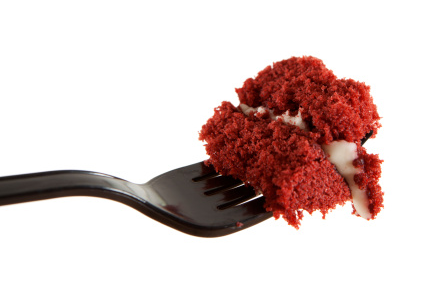
Straight to My Heart - Red Velvet Cake for Valentine's Day


Red Velvet Cake, Red Velvet Cupcakes, Red Velvet Ice Cream, Red Velvet Cookies, Red Velvet Waffles, Red Velvet ... Everything is all the rage, and has been for a few years now. Back in the day it was considered a regional dessert, common enough in the South but not well-known elsewhere. There's a bit of a joke there as the original Red Velvet Cake was developed at the Waldorf-Astoria Hotel in New York City. There is no definitive story about how it came to be popular in the South, but it was certainly a fixture at my grandmother Dorothy's Christmas table during my youth. In fact, it was such a hit with my brother Dale that to this day it's the cake he wants for his November birthday.

I'm not sure why RVC caught the imagination of the rest of the country a few years ago, but it's certainly entrenched now. I'm sure the current fad for Southern cuisine has helped keep it front and center. The problem, though, is that even when you are presented with an actual layer cake (as opposed to any other red velvet treat), it has often been bastardized. The "improved" version then often gets a reaction along the lines of "I don't understand why people make a fuss. It's just mediocre chocolate cake with a metric ton of artificial dye."

Well ... yes and no.


Thursday, June 28, 2012

Georgia Peaches in Nashville & Peach Chutney

I've lived in Tennessee a long time, but in all these years I have yet to find a decent fresh peach. It's astonishing, really. Most peaches I find at produce stands, farmers' markets, and even Whole Foods that are touted as "local" come from Kentucky or South Carolina. I don't mind a slightly distant provenance, but I'm sorry to say the peaches -- even ones from Tennessee -- aren't even very good. More often than not they aren't very sweet, or juicy, and sometimes have a weird, mealy texture. I don't think that's necessarily a function of the quality of peach that CAN be grown in those areas, but just what we wind up getting here in Nashville. I've heard Alabama peaches are good, but we don't seem to get those up here, either.

I long for the Georgia peach of my youth. I remember going to the Georgia Farmers' Market in Forest Park, just south of Atlanta and my hometown of Hapeville, GA. There were certain things we'd always load up on in the summer time in those huge outdoor sheds, peaches and watermelon being chief among them. We'd eat the peaches plain, after they'd macerated with a little sugar to form a syrup, or my mother would make peach ice cream. Of course the sepia-toned memories of childhood might make those peaches a little more tasty in retrospect than they really were, but I know they were always ripe and sweet and juicy, qualities that can be hard to find in the modern peach available to me now.

I wasn't even going to bother with peaches this year, so great was my disappointment last year. Enter The Peach Truck. Entrepreneur Stephen Rose grew up in Snellville, Georgia but was born in Ft. Valley, the epicenter of peach farming in Georgia. His aunt and uncle have a multi-generation farm in the area, Pearson Farm. Stephen's day job is in personal finance, but The Peach Truck is a sideline that grew out of his desire for Georgia peaches. He had also been disappointed by the quality of peaches in Nashville after moving to the area a couple of years ago. After describing his dilemma to his aunt & uncle, they suggested he try selling their peaches here. A year of discussion, and a spring of going door-to-door to local restaurants, and a surprisingly successful enterprise was born.

Pearson's is the peach source for some notable Atlanta restaurants, and now customers of Edley's, Burger Up, Capitol Grille, City House, and many more can enjoy creations made with Pearson's peaches.  The peaches are also available all week at the two Turnip Truck locations, and Thursday through Sunday you can buy directly from The Peach Truck itself. Stephen sets up shop from the back of a vintage pickup truck, parking in hip locales like imogene + willie in 12South, or even less hip venues like the monthly Flea Market at the Fairgrounds; you can find out where The Peach Truck is parked on any given day by following it on Twitter. In addition, this weekend they will be at the Nashville Farmers' Market, and there's currently a contest on Yelp to win a box of peaches. A bag of peaches from the truck is about 3 pounds worth and costs $6 -- about what you'd pay for gnarly Kentucky or South Carolina peaches from a produce stand. So far Stephen has been able to keep up with the burgeoning demand, and Pearson's predicts they'll be able to supply peaches through about July 15. Also, it turns out that the brutally hot weather that's causing us humans to go droopy 'round the edges is great for peaches, and this year is a bumper crop.

So what did I do with my precious booty? First, I peeled and sliced one and ate it and swooned. Then ... the dishes that usually leap to mind first when faced with a horde of fresh peaches are cobbler and pie. I did make a pie this week, and it was incredibly good. I'll probably make a cobbler with my next haul, using my mother's time-honored, super-simple Georgia cobbler recipe. (It's similar to this one on Pearson's web site:  Easy Cobbler.) Both pie and cobbler are especially delicious if you toss in a generous handful of fresh blueberries or raspberries, which come into season at the same time.

A favorite of mine, though, is Peach Chutney. Chutney can be made from many types of fruit and even vegetables; mango chutney is probably the most well-known in the U.S., owing to the ubiquity of Major Grey's Chutney in even the smallest supermarket. A Southeast Asian condiment, the chutney you usually find in the U.S. and Europe is simultaneously sweet, tart, savory, and often a little spicy. In addition to being a delicious addition to Indian dishes, chutney is terrific with chicken, pork, and some fish. It's also good on sandwiches or dolloped on cheese and crackers. It's especially good with a soft, creamy cheese like chevre or even plain cream cheese. (This last combination is kin to that Southern potluck staple of cream cheese covered in Pickapeppa or pepper jelly.)

I've used various recipes over the years, so I don't have a standard. Today I used a recipe from Epicurious.com, the parent site for Bon Appetit and the late, lamented Gourmet. I was quite pleased with the end result. Chutneys are fairly forgiving. You want the right balance of tart and sweet and heat and savory, but you can fudge things a little to make use of what you might have on hand. If you don't have white raisins but do have dark, go ahead and use the dark. For example, in this case I didn't have a whole red pepper but did have a mini red and a mini yellow, so in they went, and I didn't worry about making up the difference in volume. If I'd found the heat lacking in the final product, a pinch of red pepper flakes would have set things right.

Chutney is best made with peaches that are slightly underripe. When I snagged my 2 bags on Saturday, I was advised that they still needed ripening, and that they'd be ready to eat in a day or two. Actually, it was Tues before they were OK to eat out of hand, and by Wednesday they were perfect. On Monday evening, though, they were just right for chutney.


Fresh Peach Chutney

adapted from Epicurious.com
1/2 cup cider vinegar
3/4 cup loosely packed brown sugar
1 large sweet red pepper, seeded & diced (about 1/2 cup)
1 small white onion diced (about 1/2 cup)
1 small jalapeño pepper, seeded & minced (2 tablespoons)
1/3 cup white raisins
1 tablespoon finely chopped garlic
1 tablespoon grated ginger
1/2 teaspoon salt
1 1/2 pounds firm (not completely ripe), fresh peaches, peeled & diced

Put the vinegar and sugar into a non-reactive pot, place over medium heat and bring to a boil. Add the red pepper, onion, jalapeño, raisins, garlic, ginger, salt and simmer 12 minutes. Add the peaches and simmer an additional 10 minutes, stirring occasionally. If the peaches are still firm, cook several minutes more.

Remove from the heat and allow to cool for 15 minutes. Serve at room temperature. Transfer all excess to a clean container and refrigerate, covered, for up to one week.

Tuesday, May 1, 2012

Cornbread, Georgia Style

A while back I read a quote from Bill Maher about cornbread: "Cornbread isn't bread. It's cake." Of course, if he's only had Yankee cornbread, he would think so. But Southerners know that traditional cornbread from the Deep South doesn't have any sugar in it. Mark Twain agreed, Missourian though he was: "If God had meant for corn bread to have sugar in it, he'd have called it cake."

Traditional Southern cornbread also doesn't have flour in it, and is made from white corn, not yellow. I discussed this with an acquaintance from Alabama a few months ago, and he nodded knowingly. "White corn is for people; yellow corn is for hogs."

Now, I will eat most cornbreads put in front of me. A little sweetness beyond what the corn brings can be a good thing with certain foods. Cookbook author Pam Anderson (no, not THAT Pam Anderson - THIS Pam Anderson) adds a teaspoon of sugar to her cornbread recipe, explaining that it enhances the corn flavor. I can live with that. I enjoy the famous corn cakes from McCabe Pub, which have corn kernels in them if memory serves. I know that lots of people like to load up their cornbread with chiles or peppers.

When I make cornbread, though, I go back to basics and make my Mama's Georgia cornbread. The recipe couldn't be simpler, and it's been engraved on my brain since I was a wee one.

Barbara Ferrell's Georgia Cornbread

1 egg, beaten
1 cup buttermilk
1 cup self-rising white cornmeal / cornmeal mix*

Preheat oven to 450F. Generously grease a medium (about 8-inch) cast iron skillet** with shortening, bacon grease, or vegetable oil. Put the skillet in the oven to heat while you mix the batter.

Combine the egg & buttermilk. Gently stir in the cornmeal and mix until just moistened; it's ok if there are still a few lumps. When the fat in the skillet is rocket-hot, remove the skillet from the oven and pour in the batter. (Be careful, it may sizzle and spatter a bit.) Return pan to oven and bake until top starts to brown, 10 to 12 minutes usually. Invert the bread onto a plate immediately and slice into wedges. Serve piping hot with plenty of butter.

* Self-rising cornmeal without flour is hard to find these days, so I usually wind up using the stuff labeled "mix" and live with the bit of flour. I'm a White Lily girl, but Martha White is OK if you must. If self-rising cornmeal/mix isn't available in your area, you can make your own: http://www.food.com/recipe/self-risi...eal-mix-254874

** If you don't have a cast iron skillet of the appropriate size, of course you can use any similar-size pan you have on hand. You just want to use the sturdiest pan possible so it can take the preheating, and make sure it's not non-stick or have plastic parts that aren't suitable for the high oven temp. If you want to use a muffin tin, or have a corn pone pan, just start checking for doneness about halfway through the stated baking time.