Showing posts with label pie. Show all posts

Monday, March 13, 2017

No-Bake Chocolate Cheesecake

This is one of those convenience-food recipes that I found on some package 100 years ago, probably on the cream cheese box. I don't remember the published name, but remember that I didn't like think it was descriptive, so at some point I renamed it.

Make no mistake, it's not like a cooked cheesecake, but has a sturdier texture than your typical pie.

No-Bake Chocolate Cheesecake

16 oz. cream cheese, softened
4 squares semi-sweet baking chocolate, melted
1/3 cup sugar
8 oz. Cool Whip
1 chocolate crumb pie crust

With an electric mixer, blend together softened cream cheese, chocolate, and sugar.  Gently stir in Cool Whip.  Spoon into crust.  Refrigerate 3 hours or overnight.  Serve with additional Cool Whip if desired.

Tuesday, February 10, 2015

How to Make a Perfect, Easy Pie Crust

OK, "perfect, easy pie crust" is a lie; really, what I'm trying to say is that pie crust is not as difficult as you may fear, and that perfection is overrated. I get it, I've been there. I did not grow up with much homemade pie crust, even though my mother was a great baker. Like everyone else we knew, we used frozen shells most of the time. Like a lot of things I now make from scratch, I didn't start experimenting with pie crust until I was in my 20's. Even then, I wasn't happy with the results. I felt like a failure and stuck with frozen or refrigerated pie shells from the grocery store.

As I've continued to branch out with cooking and baking, I've revisited pie crust every now and then. I've tried Cook's Illustrated method that uses vodka and a combination of butter and shortening. I've reviewed (but never made) Alton Brown's various crusts. I've used Ruth Levy Beranbaum's exacting method which includes baking powder, vinegar, and precisely-sized cuts of carefully timed, partially-frozen butter. Making the recipe from Beranbaum, who I generally like and trust, feels like amateur brain surgery, and in the end, I just didn't like the crust that much.

A good pie crust shouldn't be brain surgery

I wouldn't discourage you from trying any and all methods to find your best pie crust, and Mr. Google can help you find the above and more. For me, though, I figured out that keeping it simple was the key to getting me to stay away from the freezer case and and the long red boxes in favor of superior taste and quality.

Saturday, March 28, 2009

Pie: Epic Fail

With the frequency of my blog entries being so shamefully low, it might appear that I'm obsessed about pie, given that this will be the second entry of the last three about pie. I'm not obsessed, but I have had another memorable pie-centered event.

You see, March 14 was Pi Day. Get it? Pi begins with the numbers 3.14, so, 3/14 every year is Pi Day. Congress even made it official this year. So, the natural way to celebrate Pi Day is to eat some pie. Not only are the two words homonyms, but pies have the added advantage of being circular. Ha.

Pi Day was on a Saturday this year, but since I have a new range that needed a workout, I thought I'd make a pie to take to work on Friday. Since I work in IT, I knew that my coworkers would be all over Pi Day and wouldn't look at me with that "you're a nerd, aren't you?" look I've gotten at other jobs.

I decided to make a basic chocolate cream, assuming that that would have the broadest appeal and wouldn't require too much work on a weeknight. (Despite the original intention to give the oven a workout, I wound up with a type of pie that wasn't baked, except for a brief stint for the crumb crust.) Not having a stand-by recipe, I perused my usual sources and narrowed it down to two candidates: A recipe from Gourmet, and one in Ruth Levy Beranbaum's
The Pie and Pastry Bible.

For the filling, I chose Ruth's -- the two recipes were very similar, but Ruth's promised to be a little darker chocolate-wise, and called for whole eggs, which appealed to me more than the egg-yolk-only formula from Gourmet. If you are unfamiliar with Ruth's books, she's a food scientist at heart, and the recipes are calculated and tested to the nth degree, so I had no fear of making a recipe of hers to serve to others without a trial run. I did use the chocolate crumb crust from the Gourmet recipe since I wouldn't have time for the dough resting needed for a good pastry crust.

Naturally, my hubris got me.

The end result, while tasting fine, was not something I'd be proud to present. You see, both recipes call for mixing cornstarch with the egg/egg yolk at the beginning; milk is added later. This runs counter to every recipe and rule of thumb I know about cornstarch, which states you should always dissolve it in cold liquid before adding to the other ingredients. I trusted that Ruth (and Gourmet) new what they were doing, and that the cornstarch would dissolve and mix in well with the eggs.

It didn't.

Now, I freely admit that this could be as much user error as anything else; perhaps I didn't use a sufficient whisking technique. The fact remains, though, that the egg was just too viscous to readily absorb the cornstarch. I soldiered on, hoping the rest of the process, including the straining called for at the end, would redeem the mixture. To make a long story short, it didn't. The end result was the right consistency, and tasted good; it had a grainy texture rather than the dead-smooth texture you expect in a cream pie, though.

So, I did not take it to work -- it just wasn't up to my standards. I did enjoy a slice Friday night, just for testing purposes, mind you.

I will make another of these pies another day ... the difference is that I will be sure to mix the cornstarch with a little of the milk before mixing with the eggs!

Sunday, January 4, 2009

Baby don't you cry, gonna make a pie

If you've seen the film Waitress, you know that the title of this post is also the first two lines of a song the eponymous waitress sings as she ... makes the pies that she loves to make. Pie IS a glorious, fabulous thing, sometimes shunted aside in favor of its showier cousin Cake. A good pie is heaven-sent, though, and should never be taken for granted. I think we've gotten used to the excuse for pie we're often presented with: Frozen, commercially-prepared products that may satisfy a sweet tooth but which fail to live up to the wonder that is good pie.

I could spend an entire post on the home-made vs. store-bought crust issue; let's just say I've availed myself of both. When time and circumstances permit, though, home-made is definitely the way to go. Don't let Fear of Piecrust stand in your way, though -- if using that frozen pastry crust or packaged crumb crust gets you into the kitchen to make a pie, then by golly go right ahead. I won't look askance.

For the holidays recently I made four different pies (plus a cake). Thanksgiving was a mincemeat pie, because that is my mother's favorite for that holiday. The filling was packaged but the double crust was made from scratch. The other Thanksgiving pie was a two-layer pumpkin: A cheesecake-like layer topped by a fairly traditional pumpkin layer. The crust for that pie was also from scratch, using the same recipe as for the mincemeat. I'm told the mincemeat was good -- I didn't have any -- but I did love the pumpkin pie.

Pumpkin Cheesecake Pie - King Arthur Flour

The pie crust itself is a bit of a story. I didn't make the crust recipe that was part of the pumpkin pie recipe; instead, I made Rose Levy Beranbaum's recipe from The Pie and Pastry Bible. The recipe, while not more difficult than others, has more steps and takes more time. Still, I think the results are worth it and it's my standard recipe. I plan on making some others for the sake of comparison (for example, Cook's Illustrated's version that uses vodka instead of vinegar). The techniques and science behind Beranbaum's is sound, though, and no matter what recipe I use in the future I'll carry what I've learned from her with me.

Basic Flaky Pie Crust - Rose Levy Beranbaum
(NOTE: I use about half the amount of vinegar called for in the recipe, and sometimes omit the baking powder, esp. if I want the crust to hold a decorative shape.)

I made the second two pies for Christmas dinner. I was in the mood for some old-school, diner-type pies, and I thought these fit the bill. The first, a coconut cream, used Beranbaum's crust again. While my parents and I like coconut and are especially appreciative of a good coconut cream pie, my siblings are strongly anti-coconut. So, I knew that pie was going to have a limited audience. The second pie was destined to have broader appeal because it was chocolate -- a real old-fashioned French Silk pie.

French Silk has gone out of style -- indeed, it can be hard to find a recipe for it -- because it calls for raw eggs. We now have pasteurized raw eggs available, though. I have heard of people using Egg Beaters or the like as well, but I haven't tried that myself. A French Silk pie is beyond decadent, though, without being heavy like the leaden, almost bombastic death-by-chocolate sort of desserts that are so popular. Creamy and, well, silky, a French Silk is everything a pie should be.

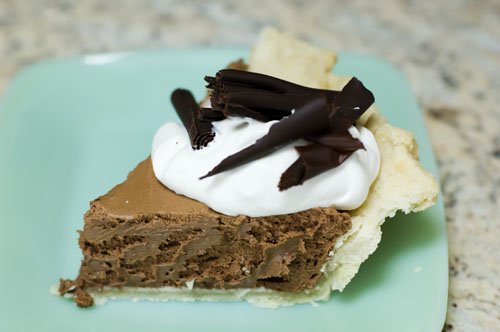
Instead of a pastry crust, I used a crumb crust made with the Nabisco "Famous Chocolate Wafers." I also grated dark chocolate over the whipped cream rather than making the chocolate curls.

French Silk Chocolate Pie - Pioneer Woman blog

Coconut Cream Pie - Bon Appetit